That morning I had no idea Freja would return before her usual hour. My evening shift at the plant meant I could stay in bed until one, and she normally left around eight after her coffee and a cheese smørrebrød. The bag sat by the door as always. I was still asleep when she slipped on her coat, grabbed the rubbish bag and stepped out.
At the bins she met our neighbour Birgitte from the third floor. Birgitte carried a cardboard box and was clearly in the mood for a chat, the way she had been ever since retiring six years earlier. She spoke without even greeting first.
“Have you heard?” Birgitte said in that solemn tone. “They finally repaired the camera. The housing manager posted a notice yesterday. Everything is recorded now and kept for two weeks.”
“About time,” Freja answered, half listening.
Birgitte nodded with satisfaction. “Yes, about time. Remember last October when the bicycle disappeared from the ground floor? Nothing could be done because the camera was broken. Now it works. Let anyone try again.”
Freja nodded, dropped the bag and continued to the metro. On the way she thought about the client meeting, the invoice that had to be sent before lunch and stopping at the pharmacy for vitamins. The camera slipped from her mind at once.
She remembered it only at four o’clock while standing at the supermarket till, shifting items onto the belt. A quiet but sharp feeling stopped her with the milk carton still in her hand.
The camera.
I usually rose at one and stepped onto the landing for a smoke, since she had banned it inside the flat. Everyone in the stairwell knew the routine. Quarter past one at the latest, half past one. Every single day. Five years in the building and nothing had altered that habit.
Except that day was my day off.
I had Jens over. We talked for a while, then I lay down on the bed. Freja set the milk on the belt and reached for her phone. She rang me once, then again. Long tones, then the recorded message. She paid, left the shop and tried once more. Still nothing.
“He is sleeping,” she told herself. Late night because of the shift, now resting.
Yet she walked toward the metro quicker than usual.
Our building is a nine-storey block from 1983 on Gothersgade in Copenhagen. The lift works only half the time and the stairwell smells of paint and old wood. The camera sits above the entrance, small and black. Once a red light blinked above it, then it stopped. We had all grown used to it being useless. Last summer someone smashed the letter boxes on the ground floor and tried to involve the police to view the footage. They were told the camera did not work. Nothing was found. After that no one expected much.
When Freja entered the stairwell she glanced up by habit. The red light shone steadily, without flickering.
She climbed the four flights on foot rather than wait for the lift. The landing was quiet. She took out her keys and opened the door.
Strange boots stood in the hallway.
Not completely strange. She had seen them before. Light brown suede, size forty-three. They stood next to my slippers, toe to toe, lined up neatly as if someone had taken care to straighten them.
She remained in the doorway for ten seconds, simply staring at the boots.
Then she removed her coat, hung it on the hook and placed the shopping bag on the floor, every movement slow and deliberate.
No sound came from the rooms.
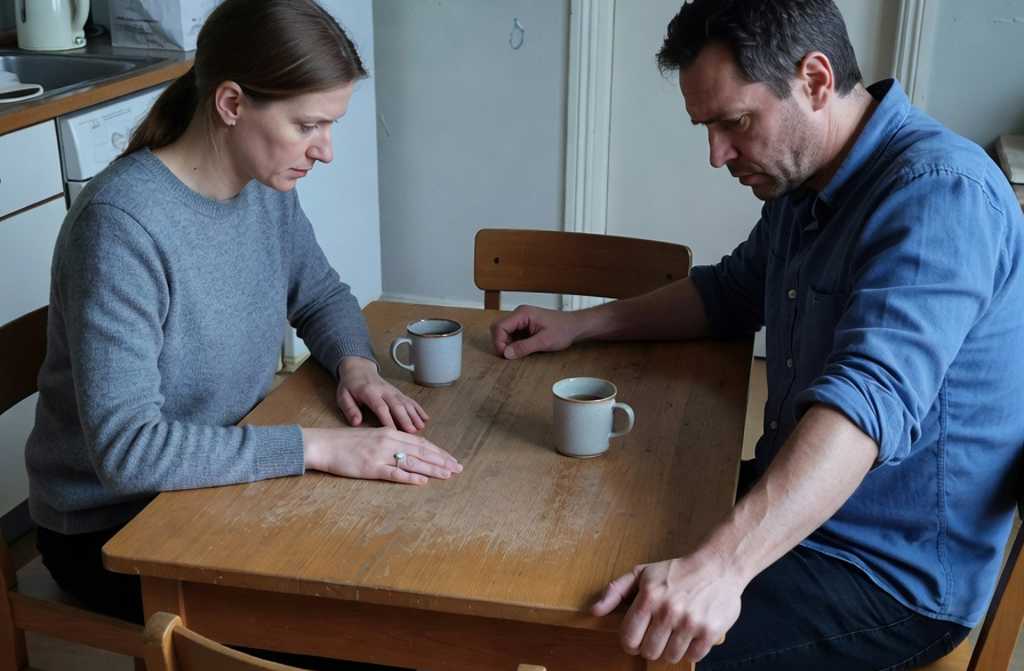
She went to the kitchen, filled the kettle and sat on the stool. Her hands rested on the table while she studied them as though they belonged to someone else. Long fingers, the silver ring with the small stone on the left hand, the one I had given on our third anniversary. We had travelled to Aarhus for three days, stayed in a small hotel by the harbour and walked the waterfront. I bought the ring at a jeweller on the main street after she noticed it in the window and remarked that it was pretty, nothing more. I remembered.
The kettle boiled. She rose, poured water into a mug and added a teabag, handling everything with the same careful attention.
She carried the mug into the hallway.
“Lars,” she said quietly.
Silence.
“Lars, I am home.”
Something moved behind the bedroom door. The bed creaked, then came a rustle, a pause and another sound she could not put into words yet understood at once.
The door opened.
I stepped out in a vest and tracksuit bottoms, hair tousled, eyes looking past her. She noticed that avoidance straight away. I had always met her gaze directly; it was one of the first things she had liked about me. Now I looked elsewhere.
“You are early,” I said.
“Yes,” she answered. “I finished sooner.”
“I was asleep.”
“I can hear that.”
Silence. She sipped her tea and watched me. I stood in the doorway without moving.
“Jens dropped by,” I said at last. “He rang from the car and I let him in. We sat talking, then he lay down for a bit.”
“Right,” she said.
“What is it?”
“Nothing.”
I passed her to the kitchen, opened the fridge and took out water.
“Jens!” I called toward the bedroom. “Come out, Freja is back!”
Another creak, a pause, then Jens appeared. Jens Andersen, my colleague for six years at the plant. She knew him from company events and my birthday the year before. Tall, fair-haired, slightly rounded shoulders. He looked freshly woken, eyes red, one cheek marked from the pillow.
“Hello, Freja,” he said. “Sorry for this. I came to see Lars and we ended up dozing.”
“It is fine,” she replied.
Both men looked at her. She kept her eyes on the mug.
“Well,” Jens said, “I had better get going. Things to do.”
“Yes,” I said. “See you.”
Jens went to the hallway, gathered his things and the front door closed.
Freja and I were alone again.
I poured water, drank it and set the glass in the sink.
“Why the silence?” I asked.
“Thinking.”
“About what?”
She placed the mug on the table.
“Listen,” she said. “Do you know the camera in the stairwell has been repaired?”
I stopped speaking. She saw something cross my face quickly, almost unseen. I set the glass on the sink edge harder than needed.
“No,” I said. “I did not know.”
“Birgitte mentioned it this morning.”
A pause followed.
“So what?” I asked.
“Nothing,” she said. “I just wanted to tell you.”
She did not start an argument. Not because she lacked words. She had plenty stored up from the last six months: small odd details she had noticed and set aside. My phone always screen-down, not only sometimes. Evening shifts that had grown more frequent than before. Replies to messages arriving later, by half an hour or an hour, yet she noticed. A scent, not aftershave, something else faint that she could not name but recognised.
One day in June I returned and said work had kept me. She asked nothing, simply set a plate on the table and went to the other room. Lying on the sofa she wondered whether she was only imagining things, whether tiredness or stress made her invent problems.
Later she rose and checked the pockets of my jacket. She found nothing, yet that discovery failed to calm her. The fact that she had searched at all told her something had shifted. Ordinary people do not search other people’s jackets.
She stayed quiet because she needed time to think.
That evening I left for my shift. She sat in the kitchen with her laptop, pretending to work. Around nine she messaged her friend Mette: “Can you talk now?”
Mette rang three minutes later.
“What happened?”
Freja described the boots, how I had come out of the bedroom, what I had said about sleeping and the repaired camera.
Mette listened without interrupting. That quiet attention was why Freja valued her above the others.
“Are you certain?” Mette asked when the story ended.
“No,” Freja answered honestly. “Not certain.”
“Then there you are.”
“But the boots stood exactly like that, toe to toe, lined up. No one arranges boots that neatly just for a chat with a friend.”
Mette stayed quiet for a moment.
“That still proves nothing,” she said.
“I know.”
“You might be mistaken.”
“I know, Mette. I understand I might be wrong. Yet when I looked at those boots I realised I already knew. Proof was not required. I simply knew.”
“A feeling is not proof.”
“I know. But sometimes a feeling is more accurate than any proof.”
“What will you do?”
“I do not know yet. Probably speak with him.”
“When?”
“Not today.”
They continued for a while about ordinary matters, the way people do when they dislike ending the call. Before hanging up Mette added, “Just do not keep it inside. If you feel bad, talk to me.” Freja promised.
I returned at half past eleven. She lay in bed reading. I looked into the room, remarked that she was still awake, not as a question but a statement, then went to shower. When I came back I lay beside her and picked up my phone.
She read without taking anything in. The same sentence passed before her eyes four times.
“Freja,” I said into the dark.
“What?”
“Are you angry?”
“No.”
A pause.
“Truly?”
“Truly.”
I turned onto my side. After some minutes my breathing grew even, whether from sleep or pretence.
She lay staring at the ceiling. A small crack ran in the left corner, from last autumn when I had said it needed filling. I never got around to it.
She was thirty-four. We had been married eight years. She recalled the first time we viewed the flat, still empty with old striped wallpaper. She had insisted the paper should be replaced before any furniture arrived. I had laughed and said wallpaper was unimportant, the sunny windows mattered more.
She remembered painting the bedroom walls together. Paint had splashed on my temple and I walked around with a white mark. She had laughed and I had laughed back.
She remembered our first real quarrel, over my mother and money. Three days of silence in the same flat had felt unbearable. On the fourth day I placed a packet of her favourite tea on the kitchen table without a word. She said nothing either. We simply sat, drank tea and began to talk, first carefully, then normally.
All of that had existed. It had not vanished.
Yet the boots had existed too.
The following day she rang the housing company.
“Hello,” she said. “I live at Gothersgade twelve, fourth floor. You repaired the entrance camera yesterday.”
“Yes,” the voice replied. “Has something occurred?”
“No. I only wish to confirm whether recordings from the past day are kept.”
“They are kept. Fourteen days.”
“Thank you.”
She set the receiver down, then lifted it again and called me.
“Hello?” I answered at once.
“Hi. Where are you?”
“At work. Has something happened?”
“No,” she said. “Nothing has happened. Listen, do you remember I mentioned the camera yesterday?”
A pause, brief yet distinct. She felt it clearly, as if marked on a tape.
“I remember.”
“The recordings are stored for two weeks. I learned that just now.”
A longer silence than required for a simple reply.
“Understood,” I said at last.
“Yes,” she said. “Understood.”
She heard my breathing through the line, steady and careful, the kind a person makes when trying to breathe normally.
“Freja,” I began.
“Not now,” she cut in. “We will talk this evening at home.”
Then she hung up.
For several minutes she sat with the phone in her hand. Fine rain drifted outside, more mist than actual drops. She watched it and realised she had not needed the recording itself. She had needed the pause on the line, the silence that stretched too long.
I arrived home early that evening, before a quarter to seven. She had not yet eaten. I set my bag down, removed my shoes and entered the kitchen. She sat at the table with tea.
I took the chair opposite. No greetings, no small talk, simply sat and met her eyes.
We remained silent for perhaps three minutes. She measured the time by the shifts in my expression: first closed, then weary, then something else she could not name precisely.
“This has been going on for some time,” I said.
“How long?”
“Seven months.”
She nodded. Seven months meant since February. She tried to recall February. We had visited my parents over the holidays. I had bought her flowers on the eighth of March, a large bouquet of yellow tulips. She had placed them in a vase on the windowsill and looked at them for days, bright and alive. Seven months.
“Who is she?”
I gave the name. Freja did not know her.
“Does she work with you?”
“No. We met by chance.”
“By chance,” she repeated.
I stayed quiet. I offered no explanations, searched for no words, simply remained silent, and that silence felt more truthful than anything I could have spoken.
“Were you planning to tell me?” she asked.
“I do not know. I thought about it. I did not know how.”
“And now you know?”
“Now there is no choice.”
“Because of the camera.”
I raised my eyes to her.
“No,” I said. “Not only the camera. Even without it, Freja, I could not go on this way. I could not do it to myself. Living beside you while knowing that it had become impossible.”
“Yet you continued for seven months.”
“Yes.”
The silence grew so complete she could hear the bathroom tap dripping. It had needed fixing for weeks. A steady small sound: drop, pause, drop.
“Do you want to be with her?”
I did not answer immediately. She studied my face and realised she knew every line by heart, every crease at the eyes that had appeared three years earlier. She remembered me looking in the mirror and joking about age while she laughed. Now those same lines seemed new.
“I do not know what I want,” I said quietly. “That is the truth. I am not avoiding the question. I truly do not know.”
“That is a poor answer.”
“I know.”
“Lars.” She spoke my name slowly, testing its sound. “You understand this is not merely ‘I do not know’. It demands an answer.”
“Yes. I understand.”
“And?”
I looked at the table.
“I do not want her,” I said. “It was something else entirely. Not something I could set against you. I do not compare. There it was different.”
“But you went there for seven months.”
“Yes.”
“What made it different?”
I remained silent for a long while.
“Easy,” I said at last. “It was simply easy. No obligations, no weight. We met and parted. No one expected anything. It felt like air from another place.”
“And here you cannot breathe?”
“No. Here is what is real. And what is real is always heavier. The fault is mine for not knowing how to handle it. Not yours.”
She rose, walked to the window, stood there and returned to the table. I followed her with my gaze.
“Very well,” she said. “Today you go to Jens. Take what you need for a few days and leave. I need time to think.”
“Freja…”
“I am not sending you away for good. I need a few days alone. Can you give me that?”
I nodded.
“All right,” I said.
I stood and went to the bedroom. She heard the wardrobe open and soft sounds of packing as I tried not to disturb her. I emerged with a small bag.
“Freja.”
“What?”
“I am sorry.”
She looked at me. The regret was genuine, visible rather than spoken.
“I know,” she said. “Go.”
For three days she remained alone.
She did not telephone me, Mette or her mother. She went to work, returned and prepared meals for one. It felt odd; she had not cooked for one person in years. She never knew how much pasta to measure. She had always cooked for two, or three at weekends when guests visited. Now half went into a container.
On the first day she cleaned the flat, washed floors, dusted and discarded items long overdue for removal. It was not anger or an attempt to erase traces, merely something for her hands to do.
That evening she rang her mother, not to confide but simply to hear a voice. Her mother spoke of the garden, neighbours and a television programme. Freja listened and noted that the voice sounded unchanged, warm and slightly tired. Certain things stayed the same.
On the second day she called the housing company again.
“May I obtain the camera recording?”
“For what reason?”
“I need to view yesterday’s recording. A personal matter.”
They explained that recordings were released only with a formal request and only for specific reasons such as theft or property damage. Simple viewing was not permitted.
She thanked them and hung up.
The recording no longer mattered. She had received what she sought the day she questioned me about the camera over the phone. Not the footage, but my reaction, the pause that lasted too long, the breathing forced to sound calm.
She had needed the truth, and she had it.
On the third day she understood the decision concerned herself, not me. Not what I had done or how it had begun, but what she wanted.
She sat by the window with coffee, the familiar view of street, trees and part of the playground. She wondered what would remain if I were gone tomorrow, what she would lose from the life we had built.
Eight years. Not merely time spent together, but eight years that had shaped something concrete. The flat. Daily routes. The habit of watching films on Friday evenings. The ease of shared silence. I knew she could not speak in the first half hour after waking. She knew I grew frustrated in large shops and turned that frustration on myself. Small, accumulated details that had become the base of everything.
Could any of it be kept once broken? Or was it like a crack in a wall that could be covered yet remained underneath?
She did not know. Yet she realised she wished to find out.
On the fourth day I wrote asking if I could return.
She answered yes.
I arrived that evening carrying bread and milk, as though I had merely been shopping. She said nothing about it. We sat in the kitchen with tea and she reflected that the important moments of our life seemed to happen at this table.
“Have you decided anything?” I asked.
“Almost,” she said.
“And?”
She looked at her hands. The ring caught the lamplight.
“I need to know one thing,” she said. “Was she something real for you, or something you cannot even define clearly?”
I stayed silent longer than thought or word choice required. She saw I was searching for honesty.
“No,” I said finally. “Not real. It was an escape. I do not know from what. From myself, perhaps. There everything was simple. No responsibility, nothing serious. Just easy.”
“And here it is difficult?”
“Here is what is real. And the real is always heavier. I was the one who could not cope with it, not you.”
She poured more tea. Her hands did not shake, which surprised her.
“Have you ended it?”
“Yes.”
“When?”
“The day before yesterday.”
“So before I asked you to come.”
“Yes.”
That detail mattered, though she could not say why. I had not finished because she called. I had finished on my own, earlier.
“Good,” she said.
“Does that mean…”
“It means we can try. Not at once, and not as though nothing happened, because that will never be true. I want you to understand that. But we can try.”
I looked at her. My expression held no simple relief, something more complex, as though I had only now grasped what I stood to lose, and the loss felt immediate.
“I need one thing from you,” she continued.
“Anything.”
“Not anything. Specifically, I want us to see a family counsellor. More than once. Are you prepared?”
“Yes.”
“You answered without thinking.”
“I am prepared, Freja. I am serious. These three days have made me think. I have understood several things.”
“What, exactly?”
I studied my hands, then her.
“I did this not because something was missing here, but because something was missing in me. The ability to stay with what is difficult. To endure the real. I ran toward what felt easy. That is cowardice, named plainly.”
She said nothing. I went on.
“I need to understand this for myself, not to persuade you. If I do not, it will happen again, perhaps not with her, perhaps with something else. But it will repeat.”
That felt like the most honest statement I had made all evening.
“Good,” she said once more.
We sat longer. The conversation shifted to other matters, work and clients, cautious and ordinary, the way people speak after long silence, beginning with what is small and safe.
“One more thing,” she said as I prepared to rise.
“Yes?”
“The tap in the bathroom has dripped for two weeks. Fix it tomorrow.”
I looked at her for a second. Something moved at the corner of my mouth, not quite a smile yet close.
“All right,” I said. “Tomorrow.”
Birgitte stopped me by the lift on Friday.
“Have you heard?” she said with the same solemn air as the week before. “The camera has been switched off again. Some technical fault, they say. The second time this month. It is disgraceful. I wrote to the housing company. They promise to repair it by the end of the week. We know how reliable that is.”
“Yes,” I agreed. “Disgraceful.”
The lift arrived. I stepped inside and pressed four.
“By the way, have you noted the dispatcher’s number?” Birgitte called as the doors closed. “I have it if you need it.”
The doors shut.
I studied my reflection in the metal surface, blurred and indistinct the way old lifts show faces. Thirty-five years old, wedding ring on my finger, coat taken from the third shelf. Tired features, somewhat marked by recent days. An ordinary face.
The camera had worked for exactly one day.
One day out of eight years. One day out of nearly three thousand days we had shared one flat, one stairwell, one roof.
One day, and that had proved sufficient.
The lift halted at the fourth floor. Doors opened. I stepped onto the landing.
The flat was quiet. Freja had not yet returned. I removed my coat, set the kettle to boil and opened the fridge. Bread, milk and a container on the shelves. An ordinary fridge. An ordinary kitchen. An ordinary flat.
An ordinary life into which a crack had reappeared. Not new, only newly visible.
I poured water into a mug and reflected that this is often how matters stand. Neither everything fine nor everything finished, but something between, where one must stand and examine. Where simple answers do not exist, yet honest questions do.
And sometimes honest answers.
The bathroom tap no longer dripped. I had repaired it that morning as promised.
This too carried meaning.
In looking back I have learned that trust, once shaken, requires deliberate daily effort to restore, and that in Danish life we value the steady, unflashy work of mending what matters rather than pretending cracks do not exist. Avoiding what is difficult only deepens the divide; facing it together, however imperfectly, is the only path that keeps a home and a bond intact.That morning I had no idea Freja would return before her usual hour. My evening shift at the plant meant I could stay in bed until one, and she normally left around eight after her coffee and a cheese smørrebrød. The bag sat by the door as always. I was still asleep when she slipped on her coat, grabbed the rubbish bag and stepped out.
At the bins she met our neighbour Birgitte from the third floor. Birgitte carried a cardboard box and was clearly in the mood for a chat, the way she had been ever since retiring six years earlier. She spoke without even greeting first.
“Have you heard?” Birgitte said in that solemn tone. “They finally repaired the camera. The housing manager posted a notice yesterday. Everything is recorded now and kept for two weeks.”
“About time,” Freja answered, half listening.
Birgitte nodded with satisfaction. “Yes, about time. Remember last October when the bicycle disappeared from the ground floor? Nothing could be done because the camera was broken. Now it works. Let anyone try again.”
Freja nodded, dropped the bag and continued to the metro. On the way she thought about the client meeting, the invoice that had to be sent before lunch and stopping at the pharmacy for vitamins. The camera slipped from her mind at once.
She remembered it only at four o’clock while standing at the supermarket till, shifting items onto the belt. A quiet but sharp feeling stopped her with the milk carton still in her hand.
The camera.
I usually rose at one and stepped onto the landing for a smoke, since she had banned it inside the flat. Everyone in the stairwell knew the routine. Quarter past one at the latest, half past one. Every single day. Five years in the building and nothing had altered that habit.
Except that day was my day off.
I had Jens over. We talked for a while, then I lay down on the bed. Freja set the milk on the belt and reached for her phone. She rang me once, then again. Long tones, then the recorded message. She paid, left the shop and tried once more. Still nothing.
“He is sleeping,” she told herself. Late night because of the shift, now resting.
Yet she walked toward the metro quicker than usual.
Our building is a nine-storey block from 1983 on Gothersgade in Copenhagen. The lift works only half the time and the stairwell smells of paint and old wood. The camera sits above the entrance, small and black. Once a red light blinked above it, then it stopped. We had all grown used to it being useless. Last summer someone smashed the letter boxes on the ground floor and tried to involve the police to view the footage. They were told the camera did not work. Nothing was found. After that no one expected much.
When Freja entered the stairwell she glanced up by habit. The red light shone steadily, without flickering.
She climbed the four flights on foot rather than wait for the lift. The landing was quiet. She took out her keys and opened the door.
Strange boots stood in the hallway.
Not completely strange. She had seen them before. Light brown suede, size forty-three. They stood next to my slippers, toe to toe, lined up neatly as if someone had taken care to straighten them.
She remained in the doorway for ten seconds, simply staring at the boots.
Then she removed her coat, hung it on the hook and placed the shopping bag on the floor, every movement slow and deliberate.
No sound came from the rooms.
She went to the kitchen, filled the kettle and sat on the stool. Her hands rested on the table while she studied them as though they belonged to someone else. Long fingers, the silver ring with the small stone on the left hand, the one I had given on our third anniversary. We had travelled to Aarhus for three days, stayed in a small hotel by the harbour and walked the waterfront. I bought the ring at a jeweller on the main street after she noticed it in the window and remarked that it was pretty, nothing more. I remembered.
The kettle boiled. She rose, poured water into a mug and added a teabag, handling everything with the same careful attention.
She carried the mug into the hallway.
“Lars,” she said quietly.
Silence.
“Lars, I am home.”
Something moved behind the bedroom door. The bed creaked, then came a rustle, a pause and another sound she could not put into words yet understood at once.
The door opened.
I stepped out in a vest and tracksuit bottoms, hair tousled, eyes looking past her. She noticed that avoidance straight away. I had always met her gaze directly; it was one of the first things she had liked about me. Now I looked elsewhere.
“You are early,” I said.
“Yes,” she answered. “I finished sooner.”
“I was asleep.”
“I can hear that.”
Silence. She sipped her tea and watched me. I stood in the doorway without moving.
“Jens dropped by,” I said at last. “He rang from the car and I let him in. We sat talking, then he lay down for a bit.”
“Right,” she said.
“What is it?”
“Nothing.”
I passed her to the kitchen, opened the fridge and took out water.
“Jens!” I called toward the bedroom. “Come out, Freja is back!”
Another creak, a pause, then Jens appeared. Jens Andersen, my colleague for six years at the plant. She knew him from company events and my birthday the year before. Tall, fair-haired, slightly rounded shoulders. He looked freshly woken, eyes red, one cheek marked from the pillow.
“Hello, Freja,” he said. “Sorry for this. I came to see Lars and we ended up dozing.”
“It is fine,” she replied.
Both men looked at her. She kept her eyes on the mug.
“Well,” Jens said, “I had better get going. Things to do.”
“Yes,” I said. “See you.”
Jens went to the hallway, gathered his things and the front door closed.
Freja and I were alone again.
I poured water, drank it and set the glass in the sink.
“Why the silence?” I asked.
“Thinking.”
“About what?”
She placed the mug on the table.
“Listen,” she said. “Do you know the camera in the stairwell has been repaired?”
I stopped speaking. She saw something cross my face quickly, almost unseen. I set the glass on the sink edge harder than needed.
“No,” I said. “I did not know.”
“Birgitte mentioned it this morning.”
A pause followed.
“So what?” I asked.
“Nothing,” she said. “I just wanted to tell you.”
She did not start an argument. Not because she lacked words. She had plenty stored up from the last six months: small odd details she had noticed and set aside. My phone always screen-down, not only sometimes. Evening shifts that had grown more frequent than before. Replies to messages arriving later, by half an hour or an hour, yet she noticed. A scent, not aftershave, something else faint that she could not name but recognised.
One day in June I returned and said work had kept me. She asked nothing, simply set a plate on the table and went to the other room. Lying on the sofa she wondered whether she was only imagining things, whether tiredness or stress made her invent problems.
Later she rose and checked the pockets of my jacket. She found nothing, yet that discovery failed to calm her. The fact that she had searched at all told her something had shifted. Ordinary people do not search other people’s jackets.
She stayed quiet because she needed time to think.
That evening I left for my shift. She sat in the kitchen with her laptop, pretending to work. Around nine she messaged her friend Mette: “Can you talk now?”
Mette rang three minutes later.
“What happened?”
Freja described the boots, how I had come out of the bedroom, what I had said about sleeping and the repaired camera.
Mette listened without interrupting. That quiet attention was why Freja valued her above the others.
“Are you certain?” Mette asked when the story ended.
“No,” Freja answered honestly. “Not certain.”
“Then there you are.”
“But the boots stood exactly like that, toe to toe, lined up. No one arranges boots that neatly just for a chat with a friend.”
Mette stayed quiet for a moment.
“That still proves nothing,” she said.
“I know.”
“You might be mistaken.”
“I know, Mette. I understand I might be wrong. Yet when I looked at those boots I realised I already knew. Proof was not required. I simply knew.”
“A feeling is not proof.”
“I know. But sometimes a feeling is more accurate than any proof.”
“What will you do?”
“I do not know yet. Probably speak with him.”
“When?”
“Not today.”
They continued for a while about ordinary matters, the way people do when they dislike ending the call. Before hanging up Mette added, “Just do not keep it inside. If you feel bad, talk to me.” Freja promised.
I returned at half past eleven. She lay in bed reading. I looked into the room, remarked that she was still awake, not as a question but a statement, then went to shower. When I came back I lay beside her and picked up my phone.
She read without taking anything in. The same sentence passed before her eyes four times.
“Freja,” I said into the dark.
“What?”
“Are you angry?”
“No.”
A pause.
“Truly?”
“Truly.”
I turned onto my side. After some minutes my breathing grew even, whether from sleep or pretence.
She lay staring at the ceiling. A small crack ran in the left corner, from last autumn when I had said it needed filling. I never got around to it.
She was thirty-four. We had been married eight years. She recalled the first time we viewed the flat, still empty with old striped wallpaper. She had insisted the paper should be replaced before any furniture arrived. I had laughed and said wallpaper was unimportant, the sunny windows mattered more.
She remembered painting the bedroom walls together. Paint had splashed on my temple and I walked around with a white mark. She had laughed and I had laughed back.
She remembered our first real quarrel, over my mother and money. Three days of silence in the same flat had felt unbearable. On the fourth day I placed a packet of her favourite tea on the kitchen table without a word. She said nothing either. We simply sat, drank tea and began to talk, first carefully, then normally.
All of that had existed. It had not vanished.
Yet the boots had existed too.
The following day she rang the housing company.
“Hello,” she said. “I live at Gothersgade twelve, fourth floor. You repaired the entrance camera yesterday.”
“Yes,” the voice replied. “Has something occurred?”
“No. I only wish to confirm whether recordings from the past day are kept.”
“They are kept. Fourteen days.”
“Thank you.”
She set the receiver down, then lifted it again and called me.
“Hello?” I answered at once.
“Hi. Where are you?”
“At work. Has something happened?”
“No,” she said. “Nothing has happened. Listen, do you remember I mentioned the camera yesterday?”
A pause, brief yet distinct. She felt it clearly, as if marked on a tape.
“I remember.”
“The recordings are stored for two weeks. I learned that just now.”
A longer silence than required for a simple reply.
“Understood,” I said at last.
“Yes,” she said. “Understood.”
She heard my breathing through the line, steady and careful, the kind a person makes when trying to breathe normally.
“Freja,” I began.
“Not now,” she cut in. “We will talk this evening at home.”
Then she hung up.
For several minutes she sat with the phone in her hand. Fine rain drifted outside, more mist than actual drops. She watched it and realised she had not needed the recording itself. She had needed the pause on the line, the silence that stretched too long.
I arrived home early that evening, before a quarter to seven. She had not yet eaten. I set my bag down, removed my shoes and entered the kitchen. She sat at the table with tea.
I took the chair opposite. No greetings, no small talk, simply sat and met her eyes.
We remained silent for perhaps three minutes. She measured the time by the shifts in my expression: first closed, then weary, then something else she could not name precisely.
“This has been going on for some time,” I said.
“How long?”
“Seven months.”
She nodded. Seven months meant since February. She tried to recall February. We had visited my parents over the holidays. I had bought her flowers on the eighth of March, a large bouquet of yellow tulips. She had placed them in a vase on the windowsill and looked at them for days, bright and alive. Seven months.
“Who is she?”
I gave the name. Freja did not know her.
“Does she work with you?”
“No. We met by chance.”
“By chance,” she repeated.
I stayed quiet. I offered no explanations, searched for no words, simply remained silent, and that silence felt more truthful than anything I could have spoken.
“Were you planning to tell me?” she asked.
“I do not know. I thought about it. I did not know how.”
“And now you know?”
“Now there is no choice.”
“Because of the camera.”
I raised my eyes to her.
“No,” I said. “Not only the camera. Even without it, Freja, I could not go on this way. I could not do it to myself. Living beside you while knowing that it had become impossible.”
“Yet you continued for seven months.”
“Yes.”
The silence grew so complete she could hear the bathroom tap dripping. It had needed fixing for weeks. A steady small sound: drop, pause, drop.
“Do you want to be with her?”
I did not answer immediately. She studied my face and realised she knew every line by heart, every crease at the eyes that had appeared three years earlier. She remembered me looking in the mirror and joking about age while she laughed. Now those same lines seemed new.
“I do not know what I want,” I said quietly. “That is the truth. I am not avoiding the question. I truly do not know.”
“That is a poor answer.”
“I know.”
“Lars.” She spoke my name slowly, testing its sound. “You understand this is not merely ‘I do not know’. It demands an answer.”
“Yes. I understand.”
“And?”
I looked at the table.
“I do not want her,” I said. “It was something else entirely. Not something I could set against you. I do not compare. There it was different.”
“But you went there for seven months.”
“Yes.”
“What made it different?”
I remained silent for a long while.
“Easy,” I said at last. “It was simply easy. No obligations, no weight. We met and parted. No one expected anything. It felt like air from another place.”
“And here you cannot breathe?”
“No. Here is what is real. And what is real is always heavier. The fault is mine for not knowing how to handle it. Not yours.”
She rose, walked to the window, stood there and returned to the table. I followed her with my gaze.
“Very well,” she said. “Today you go to Jens. Take what you need for a few days and leave. I need time to think.”
“Freja…”
“I am not sending you away for good. I need a few days alone. Can you give me that?”
I nodded.
“All right,” I said.
I stood and went to the bedroom. She heard the wardrobe open and soft sounds of packing as I tried not to disturb her. I emerged with a small bag.
“Freja.”
“What?”
“I am sorry.”
She looked at me. The regret was genuine, visible rather than spoken.
“I know,” she said. “Go.”
For three days she remained alone.
She did not telephone me, Mette or her mother. She went to work, returned and prepared meals for one. It felt odd; she had not cooked for one person in years. She never knew how much pasta to measure. She had always cooked for two, or three at weekends when guests visited. Now half went into a container.
On the first day she cleaned the flat, washed floors, dusted and discarded items long overdue for removal. It was not anger or an attempt to erase traces, merely something for her hands to do.
That evening she rang her mother, not to confide but simply to hear a voice. Her mother spoke of the garden, neighbours and a television programme. Freja listened and noted that the voice sounded unchanged, warm and slightly tired. Certain things stayed the same.
On the second day she called the housing company again.
“May I obtain the camera recording?”
“For what reason?”
“I need to view yesterday’s recording. A personal matter.”
They explained that recordings were released only with a formal request and only for specific reasons such as theft or property damage. Simple viewing was not permitted.
She thanked them and hung up.
The recording no longer mattered. She had received what she sought the day she questioned me about the camera over the phone. Not the footage, but my reaction, the pause that lasted too long, the breathing forced to sound calm.
She had needed the truth, and she had it.
On the third day she understood the decision concerned herself, not me. Not what I had done or how it had begun, but what she wanted.
She sat by the window with coffee, the familiar view of street, trees and part of the playground. She wondered what would remain if I were gone tomorrow, what she would lose from the life we had built.
Eight years. Not merely time spent together, but eight years that had shaped something concrete. The flat. Daily routes. The habit of watching films on Friday evenings. The ease of shared silence. I knew she could not speak in the first half hour after waking. She knew I grew frustrated in large shops and turned that frustration on myself. Small, accumulated details that had become the base of everything.
Could any of it be kept once broken? Or was it like a crack in a wall that could be covered yet remained underneath?
She did not know. Yet she realised she wished to find out.
On the fourth day I wrote asking if I could return.
She answered yes.
I arrived that evening carrying bread and milk, as though I had merely been shopping. She said nothing about it. We sat in the kitchen with tea and she reflected that the important moments of our life seemed to happen at this table.
“Have you decided anything?” I asked.
“Almost,” she said.
“And?”
She looked at her hands. The ring caught the lamplight.
“I need to know one thing,” she said. “Was she something real for you, or something you cannot even define clearly?”
I stayed silent longer than thought or word choice required. She saw I was searching for honesty.
“No,” I said finally. “Not real. It was an escape. I do not know from what. From myself, perhaps. There everything was simple. No responsibility, nothing serious. Just easy.”
“And here it is difficult?”
“Here is what is real. And the real is always heavier. I was the one who could not cope with it, not you.”
She poured more tea. Her hands did not shake, which surprised her.
“Have you ended it?”
“Yes.”
“When?”
“The day before yesterday.”
“So before I asked you to come.”
“Yes.”
That detail mattered, though she could not say why. I had not finished because she called. I had finished on my own, earlier.
“Good,” she said.
“Does that mean…”
“It means we can try. Not at once, and not as though nothing happened, because that will never be true. I want you to understand that. But we can try.”
I looked at her. My expression held no simple relief, something more complex, as though I had only now grasped what I stood to lose, and the loss felt immediate.
“I need one thing from you,” she continued.
“Anything.”
“Not anything. Specifically, I want us to see a family counsellor. More than once. Are you prepared?”
“Yes.”
“You answered without thinking.”
“I am prepared, Freja. I am serious. These three days have made me think. I have understood several things.”
“What, exactly?”
I studied my hands, then her.
“I did this not because something was missing here, but because something was missing in me. The ability to stay with what is difficult. To endure the real. I ran toward what felt easy. That is cowardice, named plainly.”
She said nothing. I went on.
“I need to understand this for myself, not to persuade you. If I do not, it will happen again, perhaps not with her, perhaps with something else. But it will repeat.”
That felt like the most honest statement I had made all evening.
“Good,” she said once more.
We sat longer. The conversation shifted to other matters, work and clients, cautious and ordinary, the way people speak after long silence, beginning with what is small and safe.
“One more thing,” she said as I prepared to rise.
“Yes?”
“The tap in the bathroom has dripped for two weeks. Fix it tomorrow.”
I looked at her for a second. Something moved at the corner of my mouth, not quite a smile yet close.
“All right,” I said. “Tomorrow.”
Birgitte stopped me by the lift on Friday.
“Have you heard?” she said with the same solemn air as the week before. “The camera has been switched off again. Some technical fault, they say. The second time this month. It is disgraceful. I wrote to the housing company. They promise to repair it by the end of the week. We know how reliable that is.”
“Yes,” I agreed. “Disgraceful.”
The lift arrived. I stepped inside and pressed four.
“By the way, have you noted the dispatcher’s number?” Birgitte called as the doors closed. “I have it if you need it.”
The doors shut.
I studied my reflection in the metal surface, blurred and indistinct the way old lifts show faces. Thirty-five years old, wedding ring on my finger, coat taken from the third shelf. Tired features, somewhat marked by recent days. An ordinary face.
The camera had worked for exactly one day.
One day out of eight years. One day out of nearly three thousand days we had shared one flat, one stairwell, one roof.
One day, and that had proved sufficient.
The lift halted at the fourth floor. Doors opened. I stepped onto the landing.
The flat was quiet. Freja had not yet returned. I removed my coat, set the kettle to boil and opened the fridge. Bread, milk and a container on the shelves. An ordinary fridge. An ordinary kitchen. An ordinary flat.
An ordinary life into which a crack had reappeared. Not new, only newly visible.
I poured water into a mug and reflected that this is often how matters stand. Neither everything fine nor everything finished, but something between, where one must stand and examine. Where simple answers do not exist, yet honest questions do.
And sometimes honest answers.
The bathroom tap no longer dripped. I had repaired it that morning as promised.
This too carried meaning.
In looking back I have learned that trust, once shaken, requires deliberate daily effort to restore, and that in Danish life we value the steady, unflashy work of mending what matters rather than pretending cracks do not exist. Avoiding what is difficult only deepens the divide; facing it together, however imperfectly, is the only path that keeps a home and a bond intact.